Tone library · Red Hot Chili Peppers, 1991
Flea's Blood Sugar Sex Magik bass tone
Flea's bass sound on Red Hot Chili Peppers' album Blood Sugar Sex Magik sparked a love for bass in a generation of players, including me. So I tried to find it, and to guide you to it as well.
Blood Sugar Sex Magik came out in September 1991. Rick Rubin produced it, the band recorded it living together in a rented house in Los Angeles, and it went to number 3 on the Billboard 200 and past 14 million copies. For a lot of us it's the record that made us pick up a bass in the first place.
I personally was 24 days old when this album was released, but it has had a huge impact on my bass playing, probably yours too.
A while ago I put out two short clips of me playing some parts of the album, and people kept asking how I got to the tone. Here's my answer.
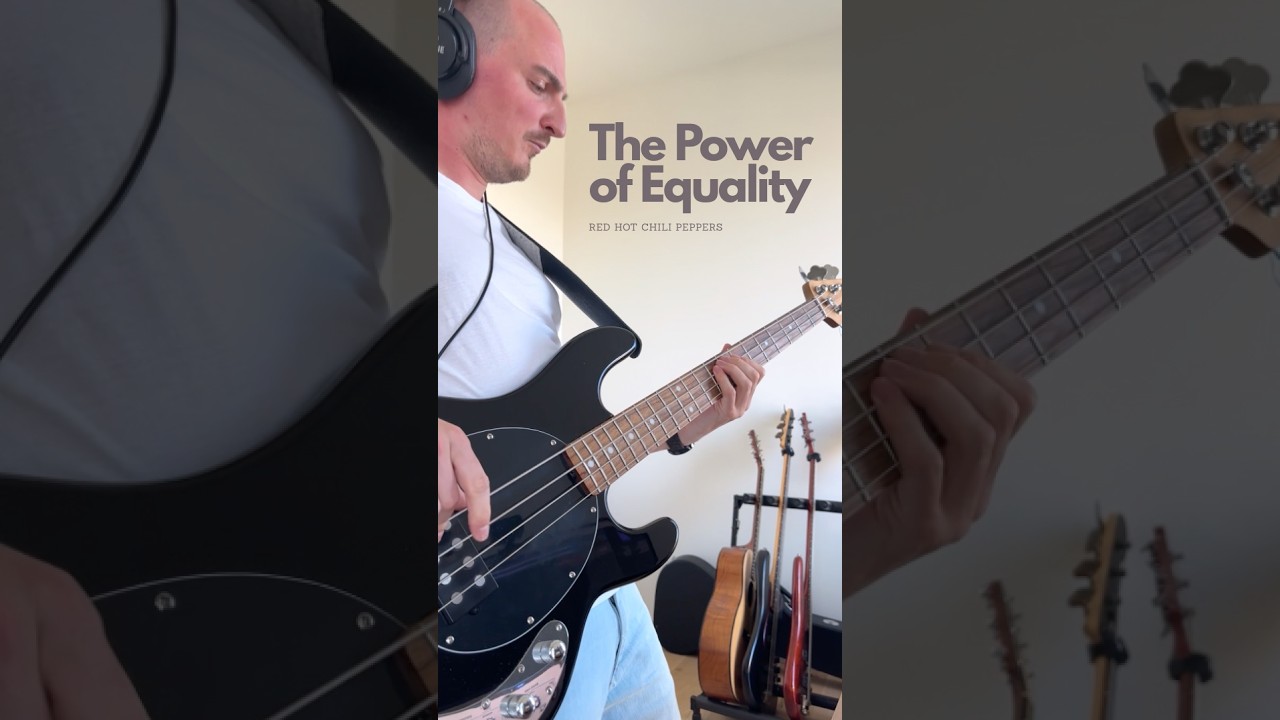

Both also on Instagram.
I'm also including what, according to the internet, Flea was actually playing to get to his tone, because it's quite different and might surprise you. 😏
1. Bass and pre-amp
I'm using my Sterling by Music Man Ray34. It has a mahogany body and a roasted maple neck with a rosewood board. Most importantly, it has one humbucker at the bridge that goes into a three-band active pre-amp.
While the Wal Mk II that Flea actually recorded with has very unique multicoil pickups, that single humbucker setup is what he mostly used live, with his Music Man StingRay and Modulus Flea Bass. It instantly gets you closer to the sound you're looking for.
For the pre-amp, make sure to turn your mids up just a bit. Not drastically, but just a bit more than the others, which we keep at around 50%.
| Control | Setting |
|---|---|
| Bass | 50 to 60% |
| Mid | 60 to 70% |
| Treble | 50 to 60% |
The knobs are centre-detented, so 50% is the detent, flat. 0% is full cut, 100% full boost, roughly 10% per hour on the clock.
Oh yes, and make sure your strings aren't worn down. Use roundwounds.
2. Playing style
This is the cheapest but hardest part of the sound. Flea plays his bass HARD when playing fingerstyle. If you're not used to playing like that, it's a level that'll hurt and give you blisters within a few minutes.
Flea also has a very specific style of slap, pointing his thumb down rather than up, unlike many other players.
There is an amazing video of Flea explaining most of his technique on YouTube. He's playing his MusicMan StingRay in it, by the way.
3. Effects chain
I'm using surprisingly little effects here, and I'm assuming Flea did the same thing.
The GX-100 handles my entire chain: compression, amp and EQ.
The one effect he certainly was using is an envelope filter. From what I could find on the internet, he recorded with a Mu-Tron III (that had a dying battery), but Flea is known to later on mostly use the EHX Q-Tron live.
So here's what that chain in the GX-100 looks like.
3.1 Compression
These are the settings I used on the Compression.
| Parameter | Setting |
|---|---|
| THRESHOLD | 80 |
| ATTACK | 50 |
| RATIO | 4:1 |
| TONE | 0 |
| DIRECT MIX | 0 |
| LEVEL | 31 |
The Ray34 is already fairly even, so start gentler than you think. If you can hear it working, it's too much.
3.2 Amp
AIRD Bass Preamp, type CONCERT. Flea ran Gallien-Krueger heads into Mesa/Boogie cabs, and of everything in the GX-100 this is the closest to that: punchy, clean, slightly solid-state. Worth testing against NATURAL BASS, which gets you to a similar place by a different route.
Don't use the X-DRIVE BASS, tempting as it looks. It's a crunch amp and it will sound dirty whatever you do to it. The aggression in this tone is not in the distortion, but in the attack and boosted mids.
Gain low to moderate: clean, with a hint of breakup when you dig in. Leave the amp's own bass, mid and treble near flat, because the real EQ happens in the next block.
| Parameter | Setting |
|---|---|
| TYPE | CONCERT |
| SP TYPE | ORIGINAL |
| GAIN | 43 |
| LEVEL | 55 |
| GAIN SW | MIDDLE |
| BASS | 52 |
| MIDDLE | 54 |
| TREBLE | 52 |
| PRESENCE | 65 |
| SAG / RESONANCE | 0 / 0 |
| Mic | DYN57, SHORT, 5 cm, level 100 |
Presence at 65 is the only control here that isn't near flat. Bass, middle and treble all sit within a couple of points of centre, so the amp is barely shaping anything. The presence is what keeps the attack alive before the EQ gets to it.
3.3 EQ
All we're really doing here is boosting the mids a bit, because that's where the growl lives.
| Parameter | Setting |
|---|---|
| LOW CUT | 40 Hz |
| LOW GAIN | +2 dB |
| LOW-MID FREQ | 800 Hz |
| LOW-MID Q | 1 |
| LOW-MID GAIN | +4 dB |
| HIGH-MID FREQ | 2 kHz |
| HIGH-MID Q | 1 |
| HIGH-MID GAIN | 0 dB |
| HIGH GAIN | 0 dB |
| HIGH CUT | 10 kHz |
| LEVEL | 0 dB |
The only setting that really matters is LOW-MID: 800 Hz, boosted +4 dB. That's the growl. Everything else in that table is sitting at or near flat.
Your bass might want a slightly different spot than mine. Turn that boost up to about +8, sweep the frequency between 500 Hz and 1 kHz, and listen for where the bark jumps out. Then pull it back down to +4. Mine landed on 800 Hz.
If it doesn't sound right
Boxy or honky: move the low-mid up toward 900 Hz or 1 kHz, or take a dB off the boost.
Muddy: try cutting around 250 to 300 Hz instead of boosting any further.
3.4 Touch Bass Wah (optional)
Controlled with the footswitch, there is an optional Touch Bass Wah to mimic Flea's Mu-Tron III or Q-Tron. Off most of the time, but used in a few songs like The Power of Equality and Sir Psycho Sexy.
| Parameter | Setting |
|---|---|
| FILTER | LPF |
| POLARITY | UP |
| SENS | 69 |
| EFFECT LEVEL | 38 |
| FREQUENCY | 50 |
| RESONANCE | 70 |
| DECAY | 50 |
| DIRECT MIX | 10 |
4. Audio interface and software
The clips were recorded straight out of the GX-100 into my Focusrite Scarlett, and from there into GarageBand.
In GarageBand I used the Modern Stack bass preset on the track.
Worth mentioning, because it means what you're hearing in those videos isn't purely the chain above. If you build the patch and it gets you close but not quite all the way, that last bit of difference is probably this.
On any other rig
Most people reading this don't own a GX-100, and honestly that doesn't matter much.
If you've got an amp or a DI with a mid control, you can get most of the way there:
- Start with the right bassIf you've got something with a humbucker at the bridge, use that one. A Music Man, a Sterling, anything in that family. It gets you closer than any EQ setting will.
- Stop cutting your midsWhatever you're playing through, that mid knob goes flat or up. Never down. Almost every modern bass preset is scooped, and this sound is the exact opposite of that.
- Find your own 800 HzIf you have a sweepable mid, boost it hard, sweep between 500 Hz and 1 kHz until the bark jumps out, then pull the boost back to a few dB. If your mid is fixed, just push it up and take a bit of treble off to compensate.
- Then it comes down to how you playFresh roundwounds, and dig in near the bridge. That gets you closer on a flat amp than everything else does on a good one.
What Flea actually used
Almost every bass track on the album is a Wal Mk II. A Music Man StingRay 5 turns up on "Funky Monks" and "The Righteous and the Wicked". Gallien-Krueger heads into Mesa/Boogie cabinets and a Mu-Tron III on a few tracks.
I'm going to guess you don't have a Wal bass, so your best bet is to use a Stingray, a Modulus Flea Bass or anything else that has a single humbucker pickup.
Sources
Album facts: Wikipedia, Blood Sugar Sex Magik. Album gear: Mixdown, Gear Rundown: Blood Sugar Sex Magik. Wal preamp design: Wal Basses, Components.